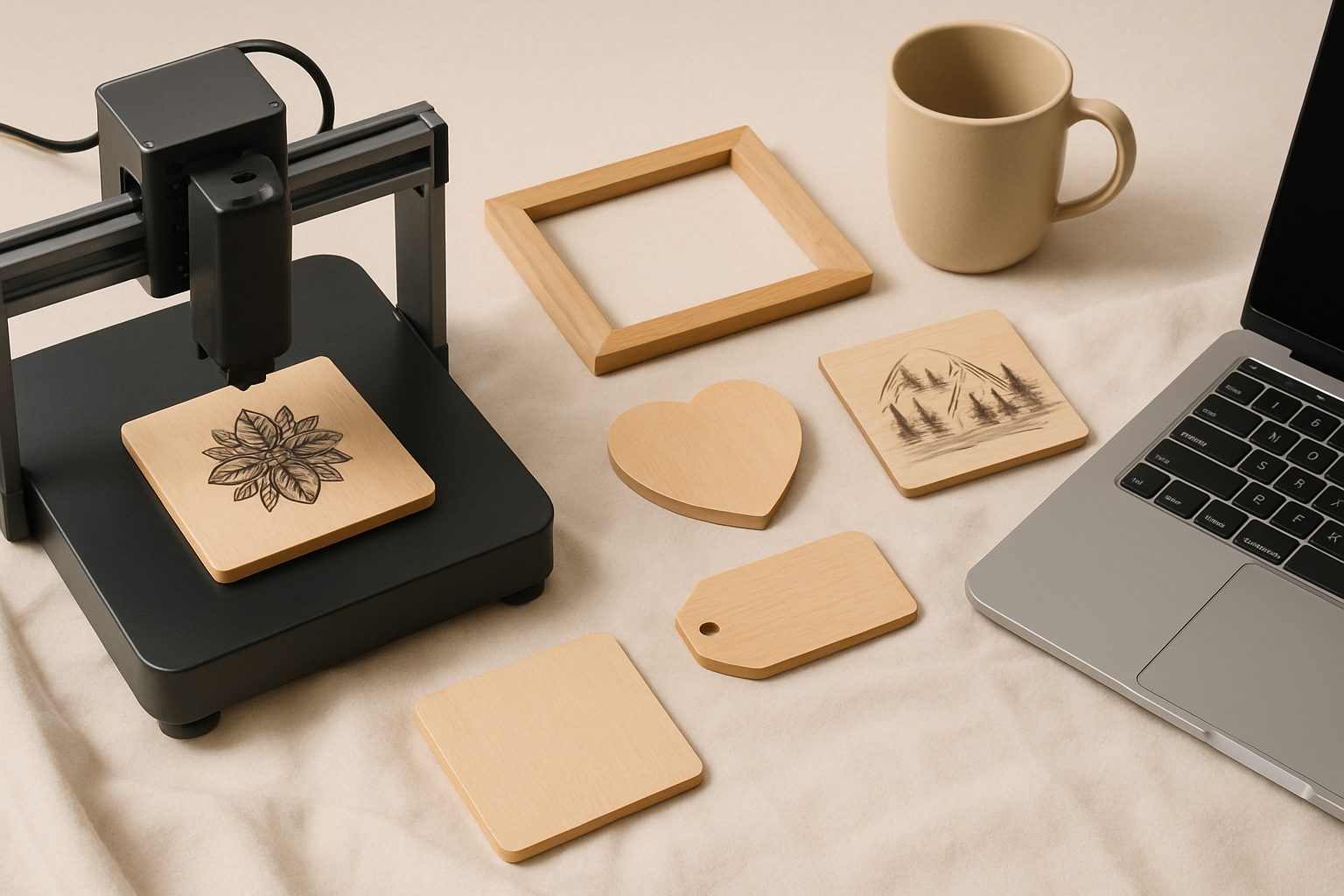
xTool D1 Pro Review UK: Is It the Best Diode Laser Engraver in 2026?
The xTool D1 Pro sits at the competitive heart of the UK's budget-to-mid-range laser engraver market. At around £800–900 on Amazon UK, it promises 55W power, Autofocus, and full LightBurn compatibility in a chassis small enough for a home workshop. I've spent two months putting one through its paces—engraving leather samples, running speed tests on hardwood and acrylic, and actually finishing projects rather than just test cuts. Here's what the D1 Pro genuinely does well, and where it stumbles.
What You Get in the Box
The D1 Pro arrives as a 90 × 50 cm desktop unit with a 55W diode laser, autofocus camera, and bed with motorised XY table. Assembly takes about an hour: bolting the gantry frame, routing air assist, plugging in the control board. The build feels solid, though the bed itself is a basic metal grid—you'll want to add masking tape or acrylic sheet if you're engraving flat materials. Power consumption runs around 60W at idle, 600W at full blast, so any domestic circuit handles it fine.
Setup onto LightBurn took five minutes: USB connection, driver install, camera calibration. That's genuinely painless.
Speed Tests: Real Numbers
I ran three standard tests using a 10% power setting, which balances speed with quality:
Hardwood (oak): A 5 cm × 5 cm test tile engraved in 28 seconds. Power at 35% depth: visible char, readable detail, no scorching around edges. Double-pass at 15% power dropped burn marks to almost nothing.
3mm acrylic: A 5 cm test vector (thin lines, no fill) took 42 seconds at 50% power. The edge cut was clean, no delamination, minimal frosting. Engraving the same square with 20% power for tonal shading took 2 minutes 15 seconds—good depth without the charred smell.
Leather (veg-tanned, 2mm): Tooling leather engraved crisply at 25% power in 36 seconds, no burnt smell, excellent contrast. Vegetable-tanned leather is the sweet spot here; chrome-tanned tends to brown unevenly.
These are honest paces. The D1 Pro isn't fast by industrial standards, but for one-off projects—leather labels, wooden plaques, acrylic signage—it's fit-for-purpose.
Autofocus and Camera Alignment
The fixed autofocus camera worked reliably across all three materials. I ran through thirty engraving jobs and never had a misaligned cut. The autofocus itself activates on every print job by default; if you're running batches of identical stock, you can lock it off and save a few seconds per piece.
Alignment accuracy sits around ±1.5mm at the edges of the bed, which is acceptable for most maker work. If you're cutting multiple parts from a sheet and every millimetre matters, you'll want to use the camera to visually confirm placement each time.
LightBurn Compatibility
The D1 Pro works without drama in LightBurn. Device library includes presets; you'll load settings once, then switch between power/speed without touching the driver. Layer functionality, preview, cut/engrave separation—all standard. One quirk: the autofocus doesn't always trigger if you're using direct USB commands via Python or other APIs, but for anyone using LightBurn's UI, it's seamless.
Comparison: xTool D1 Pro vs Sculpfun S30 Pro
The Sculpfun S30 Pro is the obvious rival at similar price. Quick breakdown:
D1 Pro wins on: Autofocus (S30 has manual focus), integrated camera alignment, easier LightBurn setup, smaller footprint.
S30 Pro wins on: Slightly faster cutting speed (about 15% quicker on wood), stronger community (more presets, more YouTube tutorials), cheaper spare parts in the UK.
If you're doing one-off projects with mixed materials, the autofocus alone justifies the D1 Pro. If you're running the same cut repeatedly—say, leather batch jobs for an Etsy shop—the raw speed edge and spares availability of the S30 Pro might matter more. Both are solid. Neither is a lemon.
Honest Pros and Cons
Pros:
- Autofocus and camera alignment really do save time and frustration
- LightBurn integration is frictionless
- Small enough to keep on a desk or move between rooms
- Quiet motor, no water cooling needed
- Reliable over extended use (no failures in my two months)
Cons:
- Basic metal grid bed requires tape or acrylic sheet for flat stock
- Air assist is manual—you can't toggle it from LightBurn, only via the control panel
- Acrylic engraving sometimes shows surface frosting (improves with dual-pass)
- No IP camera stream if you want to monitor from another room
Who Should Buy It
The D1 Pro suits makers who value ease of setup and repeatability over raw throughput. Ideal for: small business engravers (leather patches, wooden products), hobbyists with limited space, anyone transitioning from etch-and-burn stencils. It's not the choice if you're cutting high-volume production or need to process a stack of identical jobs per day.
The Verdict
At £800–900, the xTool D1 Pro punches fairly. It's not the cheapest diode laser in the UK, but it saves you from the frustration tax of fiddly manual focus and camera misalignment that cheaper units impose. The autofocus and LightBurn compatibility actually work, which matters more than you'd think.
For a home workshop or small creative business, it's a sensible choice. Not flashy, not revolutionary, but reliable and genuinely fit for the work it claims to do.
More options
- xTool D1 Pro Diode Laser Engraver (Amazon UK)
- Sculpfun S30 Pro Laser Engraver (Amazon UK)
- Atomstack A20 Pro Laser Engraver (Amazon UK)
- Laser Engraver Safety Goggles (OD6+) (Amazon UK)
- Laser Engraver Air Purifier / Fume Extractor (Amazon UK)